
IsThisAPic / Blog
How to Spot AI Art: Visual Clues and Practical Checks
Learn to inspect visual clues, trace an artwork's source, and interpret detection scores with a documented painting and known AI-generated examples.
To learn how to spot AI art, combine three checks: inspect the image, investigate its source, and use a detector as an additional signal. A strange hand or a polished surface can justify a closer look, but neither establishes how an artwork was made.
The useful question is not just “Does this look like AI?” It is “What evidence supports that conclusion?” This guide uses a documented painting and two known AI-generated images to show the difference.
How to spot AI art: a quick checklist
- Start with the best available image. Examine the original upload if possible, rather than a tiny thumbnail or a screenshot.
- Follow details across the scene. Check whether objects, edges, repeated patterns, and lettering remain coherent.
- Account for artistic choices. Stylization, unusual perspective, and deliberate distortion are not evidence of AI on their own.
- Find the original source. Look for an artist's page, a collection record, or documented creation steps.
- Add a detection result when useful. Read it alongside the source and visual evidence, not as a replacement for either.
If you already have an image to examine, you can open the IsThisAPic image detector. The examples below explain what to check before interpreting a score.
Inspect relationships, not just individual flaws
Zoom in enough to follow an object, then return to the whole composition. A detail that seems wrong in isolation may make sense once you see its surroundings.
Objects and repeated structures
Trace one railing, necklace, window frame, or patterned sleeve from end to end. Does it continue consistently? Do parts merge into a neighboring object? If a repeated shape changes, could perspective or an obstruction explain it?
The same approach applies to anatomy. Rather than counting visible fingers without context, check what is hidden, where the joints bend, and how a hand connects to the arm. An artist's drawing mistake and an AI-generated mistake can look similar.
Treat an unexplained inconsistency as a reason to investigate. It is not a reliable label for the entire image.
Text, textures, and materials
Read any lettering instead of assuming that text-like marks form words. Inspect where a material changes: fabric meeting skin, leaves crossing a window, or a bowl overlapping its contents. Ask whether the transition is understandable.
Do not reverse the rule: readable text and convincing textures do not establish human authorship. Likewise, a painter may deliberately suggest lettering with loose marks rather than draw legible words.
Light, reflections, and shadows
Compare the apparent light direction across several surfaces. If a reflection seems disconnected from an object, look for another light source, curved glass, or an artistic choice before drawing a conclusion.
Lighting analysis is especially easy to overstate. A dramatic glow, shallow depth of field, or glossy finish is a style observation, not a diagnosis. Write down the specific mismatch you can explain rather than relying on a general “AI look.”
Three examples: appearance versus evidence
These examples illustrate a checking method. They are not a balanced test set, and their different styles and subjects should not be used to measure detection accuracy.
1. Unusual perspective in a documented painting
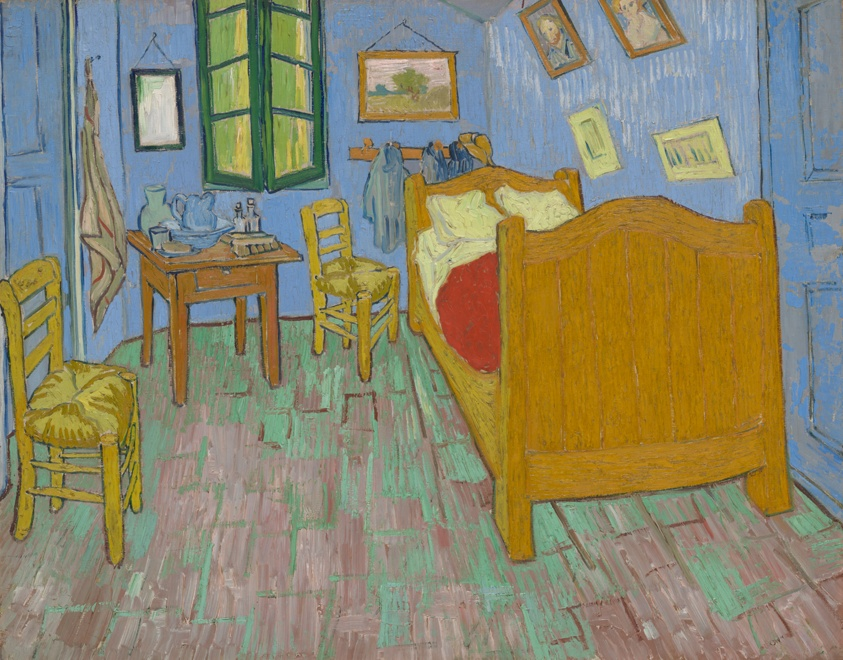
Vincent van Gogh, The Bedroom, 1889. Art Institute of Chicago, Helen Birch Bartlett Memorial Collection. The museum marks this image as public domain. View the collection record.
Look at the bed, the chairs, and the directions of the floorboards. The room does not resemble a neutral architectural photograph. If your rule were “unusual geometry means AI,” this painting would be a useful counterexample.
The reason we identify the underlying work as human-made is its documented attribution and date, not a detector score or the neatness of its perspective. The museum's public collection data identifies the artist and year.
That record supports this particular work. It does not authenticate every edited copy or imitation someone might circulate under the same title. We have not run a detector test on this reproduction for the article.
2. A convincing scene that is known to be generated

AI-generated example created for IsThisAPic on September 27, 2026. It depicts an imagined scene, not a documented photograph of a building.
The sunset, ocean texture, and glass surfaces give this image a coherent first impression. Follow the balcony railing and window divisions, then inspect where the curved structure meets the cliff. These are useful places to examine continuity; they are not features we are claiming prove AI generation.
We know the source because this image was generated for our own examples. Without that context, neither impressive detail nor an unusual building would settle the question.
This demonstrates the limit of “spot the obvious error.” A useful inspection can end with no decisive visual clue. The next step is to investigate the source, not to declare the image authentic.
3. A surreal subject that still needs a source
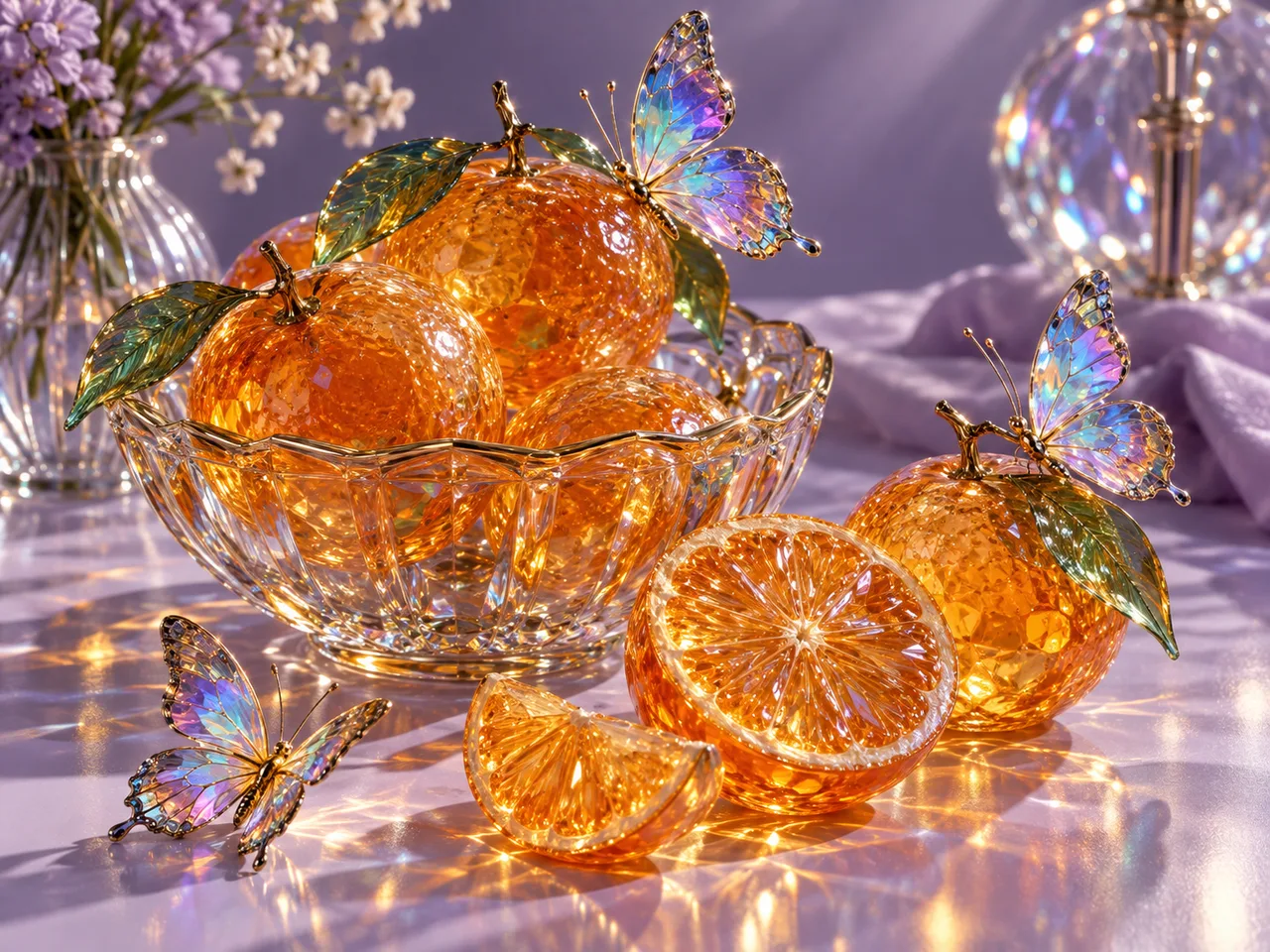
AI-generated example created for IsThisAPic on September 27, 2026.
Here, orange slices look like glass and butterflies resemble decorative objects. Examine the bowl rim, overlapping fruit, and transparent surfaces. Notice how much information overlaps in a small area.
The unusual subject is not the evidence of generation. A person could paint a surreal still life, photograph glass ornaments, or create a conventional 3D render. Our source record, rather than the subject matter, establishes how this particular example was made.
For the two generated WebP files shown above, checks of those exact files on September 30 returned an AI detection score of 99/100 each. These individual scores do not mean 99% accuracy, prove that all generated art is detectable, or predict the result for a screenshot or edited copy.
Check where the artwork came from
When deciding how to tell if art is AI-generated, source evidence can be more informative than another minute of staring at pixels.
Start with the page that posted the image. Does it identify a creator? Can you follow that attribution to an original portfolio, museum collection, or publication? If the same image appears elsewhere, compare the versions and read the surrounding description.
A reverse image search can help locate earlier appearances. The earliest result you find is only the earliest one that search surfaced; it is not automatically the original.
For a contemporary artist, look for relevant sketches, intermediate files, or a documented process. Ask a neutral question about how the piece was created instead of treating suspicion as an accusation. A missing process video is not proof of AI use, and a video should be evaluated in context too.
Keep separate questions separate: whether AI contributed to an image, whether a depicted event happened, and whether you have permission to use the image are different issues.
What metadata and Content Credentials can tell you
File metadata may provide clues about software or processing. Treat ordinary metadata as supporting context rather than an unalterable record.
Content Credentials provide a different kind of evidence: signed information about a file's recorded origin or editing history. The C2PA explainer describes how these records are checked for integrity and trust. That is not the same as certifying that everything depicted is true.
Credentials may be absent or become separated from a file. C2PA's FAQ explains that metadata can be stripped and describes ways associated credentials may be recovered. Missing credentials alone therefore do not establish AI generation.
This is a separate provenance check, not a feature claimed for the IsThisAPic detector.
Use an AI art detector as a second opinion
After inspecting the image and checking its source, a detector can add another piece of evidence. Where available, use the original file and keep a note of which version you checked.
NIST's review of synthetic-content techniques explains that detection evaluation needs to account for the kinds of content encountered, changes such as compression and resizing, and appropriately labeled human and synthetic samples. A result on one attractive example is not a substitute for that evaluation.
When reading an IsThisAPic result:
- Likely AI-generated means stronger generation signals were detected; it remains an estimate.
- No strong AI-generation signals detected does not establish that a person created the image or that it is an authentic photograph.
- Inconclusive means the result does not support a clear classification. It does not, by itself, mean that only part of the image was edited with AI.
If the result conflicts with a credible source, preserve both pieces of information and investigate the disagreement. Do not turn a model score into an accusation against an artist.
Check an image with IsThisAPic, then compare the result with what you learned about its origin.
Common questions
Can you always tell whether art is AI-generated by looking?
No. Visual inspection can reveal inconsistencies worth checking, but a plausible image may offer no decisive clue. The documented source and creation process matter, especially when appearance alone leaves the question open.
Are strange hands or unreadable words proof?
No. They can be useful inspection points, but drawing choices, mistakes, small image size, and stylized marks can produce similar observations. Explain the specific inconsistency and seek corroborating evidence.
What if the image mixes human work and AI?
Look for information about the workflow: what was drawn, generated, retouched, or composited. A single image-level score does not map every edited region or identify the contribution of each tool.
What should I do when the evidence is insufficient?
Keep the source link, record the file version and any detection result, and describe what remains unknown. Learning how to spot AI art also means recognizing when the available evidence does not justify a confident label.